
Top articles
- Wear-Resistant Ceramic Tiles: Industrial Wear Protection Solution
- New Benchmark in Impact Resistance and Wear Protection:Three-in-One Ceramic Vulcanized Liners
- Wear-Resistant Ceramic Liners for Cyclone Separators
- What is a wear-resistant ceramic composite pipe?
- Performance Advantages and Application Fields of Alumina Ceramic Tubes
- Wear-Resistant Alumina Ceramic Liner Plate: Technical Specifications and Application Overview
- Wear-Resistant Alumina Hexagonal Ceramic Liner Tiles: A Reliable Choice for Industrial Wear Protection
- Wear-Resistant Alumina Ceramic Lining Bricks: A High-hardness, Long-Life Grinding Solution
- Alumina Ceramic Grinding Balls: High-Purity, Wear-Resistant Grinding Media
- Visit Us at UGOL ROSSII & MINING 2026 – Booth 1-D22
Latest articles
- Wear-Resistant Ceramic Tiles: Industrial Wear Protection Solution
- New Benchmark in Impact Resistance and Wear Protection:Three-in-One Ceramic Vulcanized Liners
- Wear-Resistant Ceramic Liners for Cyclone Separators
- What is a wear-resistant ceramic composite pipe?
- Performance Advantages and Application Fields of Alumina Ceramic Tubes
- Wear-Resistant Alumina Ceramic Liner Plate: Technical Specifications and Application Overview
- Wear-Resistant Alumina Hexagonal Ceramic Liner Tiles: A Reliable Choice for Industrial Wear Protection
- Wear-Resistant Alumina Ceramic Lining Bricks: A High-hardness, Long-Life Grinding Solution
- Alumina Ceramic Grinding Balls: High-Purity, Wear-Resistant Grinding Media
- Visit Us at UGOL ROSSII & MINING 2026 – Booth 1-D22
Your browsing history

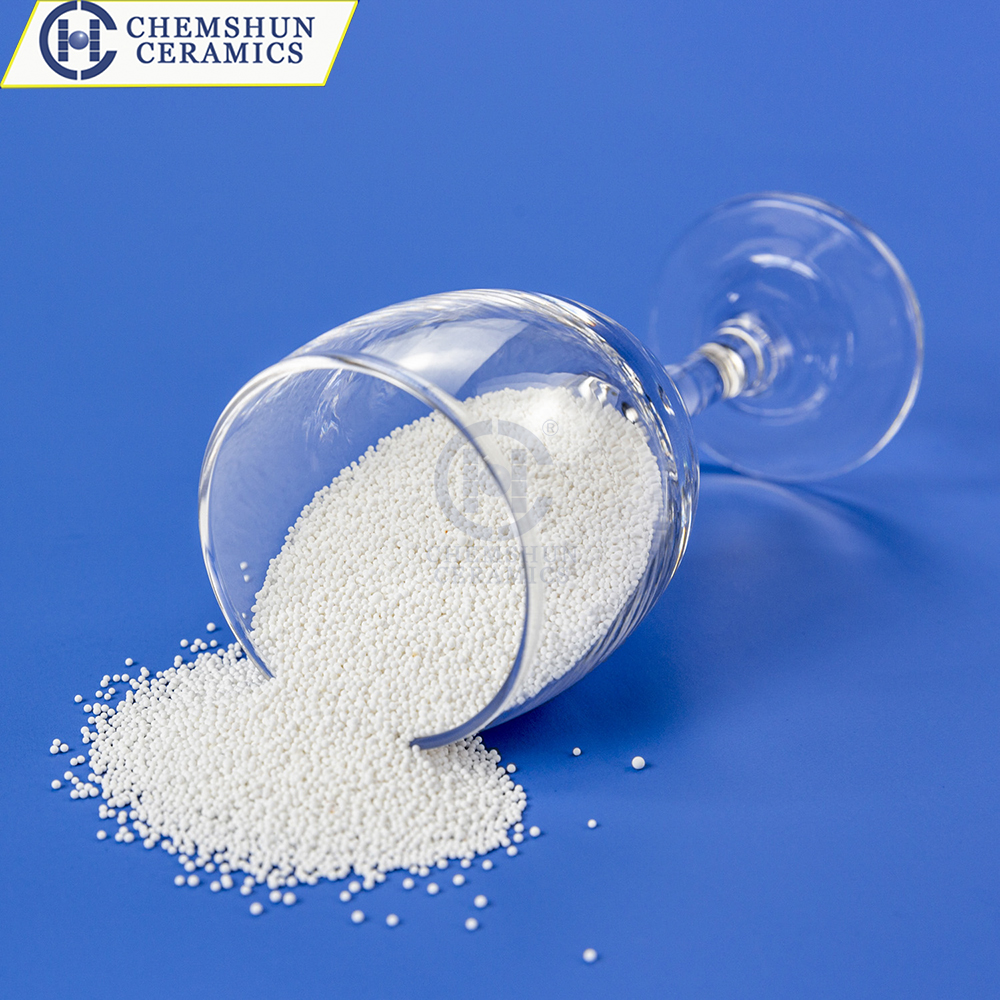
Wear-resistant Alumina Ceramic Beads: Performance Parameters and Industrial Applications
Wear-resistant alumina ceramic beads are manufactured from high-purity α-alumina (Al2O3 content ≥92%) through rolling or isostatic pressing, followed by sintering at 1600-1700℃. The resulting dense microstructure with grain size controlled between 2-5μm provides excellent impact resistance and wear resistance, making them suitable for various fine grinding and dispersion processes.
Typical physical performance parameters are as follows: bulk density 3.6-3.9 g/cm³, Mohs hardness 9 (equivalent to HV 1200-1400), Rockwell hardness HRA 85-88. Crushing strength per bead ≥2000 N (for 3mm diameter samples), and self-wear rate ≤0.01% per hour (tested according to ASTM D4054). Water absorption is below 0.01%, and roundness deviation ≤0.05mm. These data ensure continuous operation for over 8000 hours in high-speed stirred mills or bead mills while maintaining effective grinding capacity.
Primary application areas include: ultrafine grinding of non-metallic mineral powders (calcium carbonate, kaolin, zirconium silicate), dispersion of paints and inks, homogenization of electronic ceramic slurries, and preparation of pesticide suspension concentrates. Recommended bead size range is 0.6-6.0mm, selected based on grinding equipment type (vertical or horizontal bead mill) and initial particle size of the material. Compared with zirconia beads, alumina ceramic beads reduce grinding media cost by approximately 40-60% while avoiding metal contamination during the grinding process.
Selection recommendations: for low-viscosity slurries (<500 cP), use small beads of 0.6-1.5mm; for high-viscosity or hard materials (Mohs hardness >6), use larger beads of 2.0-4.0mm. Periodically screen out broken beads (allowable breakage rate <0.5%/1000 hours). The product complies with ROHS directives and contains no hazardous heavy metals. Under proper usage conditions, service life reaches 8000-12000 hours, offering better overall cost-effectiveness than steel balls and glass beads.