
Top articles
- Wear-Resistant Ceramic Tiles: Industrial Wear Protection Solution
- New Benchmark in Impact Resistance and Wear Protection:Three-in-One Ceramic Vulcanized Liners
- Wear-Resistant Ceramic Liners for Cyclone Separators
- What is a wear-resistant ceramic composite pipe?
- Performance Advantages and Application Fields of Alumina Ceramic Tubes
- Wear-Resistant Alumina Ceramic Liner Plate: Technical Specifications and Application Overview
- Wear-Resistant Alumina Hexagonal Ceramic Liner Tiles: A Reliable Choice for Industrial Wear Protection
- Wear-Resistant Alumina Ceramic Lining Bricks: A High-hardness, Long-Life Grinding Solution
- Alumina Ceramic Grinding Balls: High-Purity, Wear-Resistant Grinding Media
- Visit Us at UGOL ROSSII & MINING 2026 – Booth 1-D22
Latest articles
- Wear-Resistant Ceramic Tiles: Industrial Wear Protection Solution
- New Benchmark in Impact Resistance and Wear Protection:Three-in-One Ceramic Vulcanized Liners
- Wear-Resistant Ceramic Liners for Cyclone Separators
- What is a wear-resistant ceramic composite pipe?
- Performance Advantages and Application Fields of Alumina Ceramic Tubes
- Wear-Resistant Alumina Ceramic Liner Plate: Technical Specifications and Application Overview
- Wear-Resistant Alumina Hexagonal Ceramic Liner Tiles: A Reliable Choice for Industrial Wear Protection
- Wear-Resistant Alumina Ceramic Lining Bricks: A High-hardness, Long-Life Grinding Solution
- Alumina Ceramic Grinding Balls: High-Purity, Wear-Resistant Grinding Media
- Visit Us at UGOL ROSSII & MINING 2026 – Booth 1-D22
Your browsing history

Application of Wear-Resistant Alumina Ceramic Lining Bricks in Ball Mills
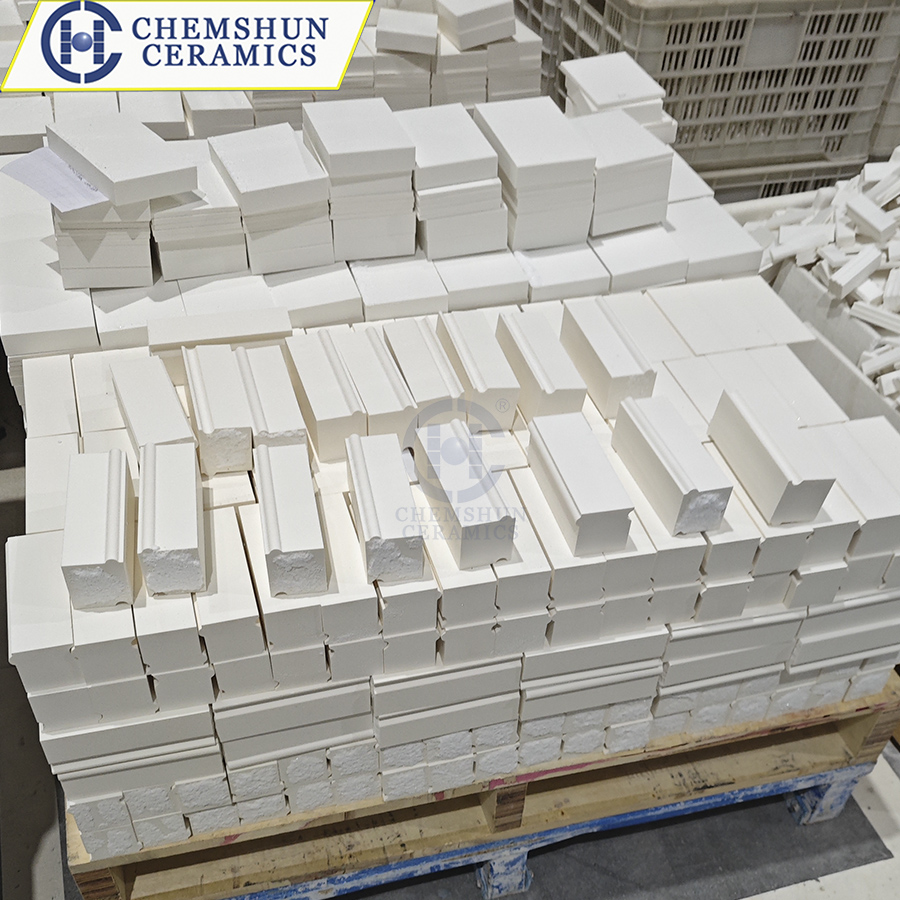
Wear-resistant alumina ceramic lining bricks are manufactured from high-purity alumina (Al2O3 content ≥92%) through high-temperature sintering. They exhibit a Mohs hardness of 8-9, bulk density ≥3.60 g/cm³, and water absorption ≤0.01%. Their wear resistance is 266 times that of manganese steel and 172 times that of chromium steel. Suitable for ball mill shell linings, these bricks significantly reduce impact wear on the mill shell from grinding media and prevent ferrous contamination of materials. Common specifications include rectangular bricks, wedge bricks, and profiled bricks, with thickness ranging from 40 mm to 90 mm.
The use of alumina ceramic lining bricks in ball mills enhances grinding efficiency and reduces energy consumption. Compared with conventional high-manganese steel liners, ceramic bricks have a lower surface friction coefficient (0.1–0.2), leading to reduced material flow resistance and a 10%–15% decrease in mill specific power consumption. Additionally, the wear rate of ceramic bricks is below 0.01 mm/h under dry grinding conditions, extending the liner replacement cycle to 3–5 years and minimizing downtime for maintenance. For wet grinding, the chemical inertness of alumina bricks withstands slurry pH values of 3–11, with no risk of corrosive leaching.
These lining bricks are widely used in ball mills for non-metallic minerals, fine ceramics, paints, cement, and metallurgical industries. Recommended process parameters: use alumina grinding balls (density ≥3.80 g/cm³) with a filling rate of 30%–45%, and mill rotational speed at 65%–75% of critical speed. For materials with a Mohs hardness below 7, alumina ceramic lining bricks enable a product particle size D50 ≤2 μm (wet grinding) and grinding media wear ≤0.08 kg per ton of material.
During installation, temperature-resistant epoxy or ceramic adhesive is applied to bond the lining bricks to the inner wall of the ball mill, with an adhesive layer thickness of 2–3 mm, followed by a 72-hour curing period before operation. Regularly inspect the brick surface for cracks or spalling; replace individual bricks when local wear depth exceeds 1/3 of the original thickness. Although the initial capital cost is 30%–50% higher than that of metal liners, life cycle cost (LCC) analysis shows a 40%–60% reduction in total cost for alumina ceramic lining bricks, making them particularly suitable for high-purity material grinding and flexible production lines with frequent product changeovers.